
Children Aren’t Failing to Learn to Read - They’re Stopping Reading, New Whitepaper Reveals
New Research from Auris Tech shows that declining reading engagement – not early instruction – is driving stagnant reading outcomes across England.
Introduction
Over the past decade, England has made real progress in teaching children to read. Today, around nine in ten pupils meet the expected standard in phonics by the end of Key Stage 1.
Yet by the end of primary school, only around three quarters reach the expected reading standard and that figure has remained largely unchanged for over a decade.
So what’s going wrong?
A new whitepaper from Auris Tech argues that the issue is not how children learn to read – but whether they continue reading once they can.
Children are reading less than ever before
Reading development doesn’t stop once decoding is secure. In fact, that’s when it becomes most dependent on practice.
The more children read, the more their language comprehension develops. This is described as accumulating “reading miles”.
But those reading miles are declining.
Only 18.7% of children aged 8 to 18 now report reading daily in their free time – a decline of more than 50% since 2005.
In other words, fewer children are doing the one thing that most strongly drives reading development: reading regularly.
The missing piece: why children stop reading
Reading doesn’t continue automatically once children can decode. It depends on something less visible, but more powerful: engagement.
Reading engagement is a child’s sustained willingness to invest effort and attention in reading over time.
The whitepaper identifies two key drivers of engagement:
Reading Enjoyment – does reading feel rewarding?
Reading Confidence – does reading feel achievable?
When both are strong, children are far more likely to pick up a book, stick with it when it gets difficult and return to reading over time.
When either weakens, reading becomes fragile. And when reading feels effortful or unrewarding, it’s easily replaced by alternatives that are simpler, faster, and more immediately engaging.
Reading is now competing in a different attention environment
This shift isn’t happening in isolation.
Today children are growing up in a digital environment designed around:
Instant feedback
Visible progress
Low barriers to entry
Independent reading offers almost none of these by default. It requires sustained effort, provides delayed reward, and often gives little feedback on progress.
That doesn’t make reading less valuable – but it does make it harder to sustain.
A different approach: making reading feel achievable and rewarding
If reading behaviour depends on engagement, the question becomes: how can we strengthen it?
The whitepaper explores one approach: ASR-enabled reading aloud.
In simple terms, this is technology that listens as children read aloud and responds in real time. As they read:
Correct words are confirmed instantly
Mistakes can be corrected immediately
Progress is made visible
The goal isn’t to replace reading, but to change how it feels in the moment:
more responsive, more supported, and more rewarding.
What happens when reading becomes more engaging
The paper draws on data from the National Read-Aloud Challenge, involving more than 5,000 pupils across 265 schools.
The results point to consistent changes in behaviour:
83% reported increased reading frequency
89% reported increased reading enjoyment
86% reported increased reading confidence
Just as importantly, pupils didn’t disengage when reading became difficult. They were more likely to retry and persist, one of the clearest behavioural signals of sustained engagement.
These patterns suggest that when reading feels both achievable and rewarding, children are more likely to continue, and to build the reading miles that support long-term development.
A shift in how we think about reading
For years, the focus of literacy improvement has been on how children learn to read. And in many ways, that focus has worked.
But this paper points to a different challenge.
Once decoding is secure, progress depends less on instruction and more on whether children continue reading over time.
That means the question is no longer just:
Can children read?
But:
Do they keep reading?
A way forward
If reading outcomes are to improve, the conditions that sustain reading need to be addressed directly.
This means supporting:
Regular, independent reading
Visible progress and feedback
Experiences that build both confidence and enjoyment
In a world where attention is increasingly contested, reading cannot rely on effort alone. It must also feel achievable and rewarding.
Because if phonics gives children the ability to read, it is the reading miles they accumulate that determine how far they go.
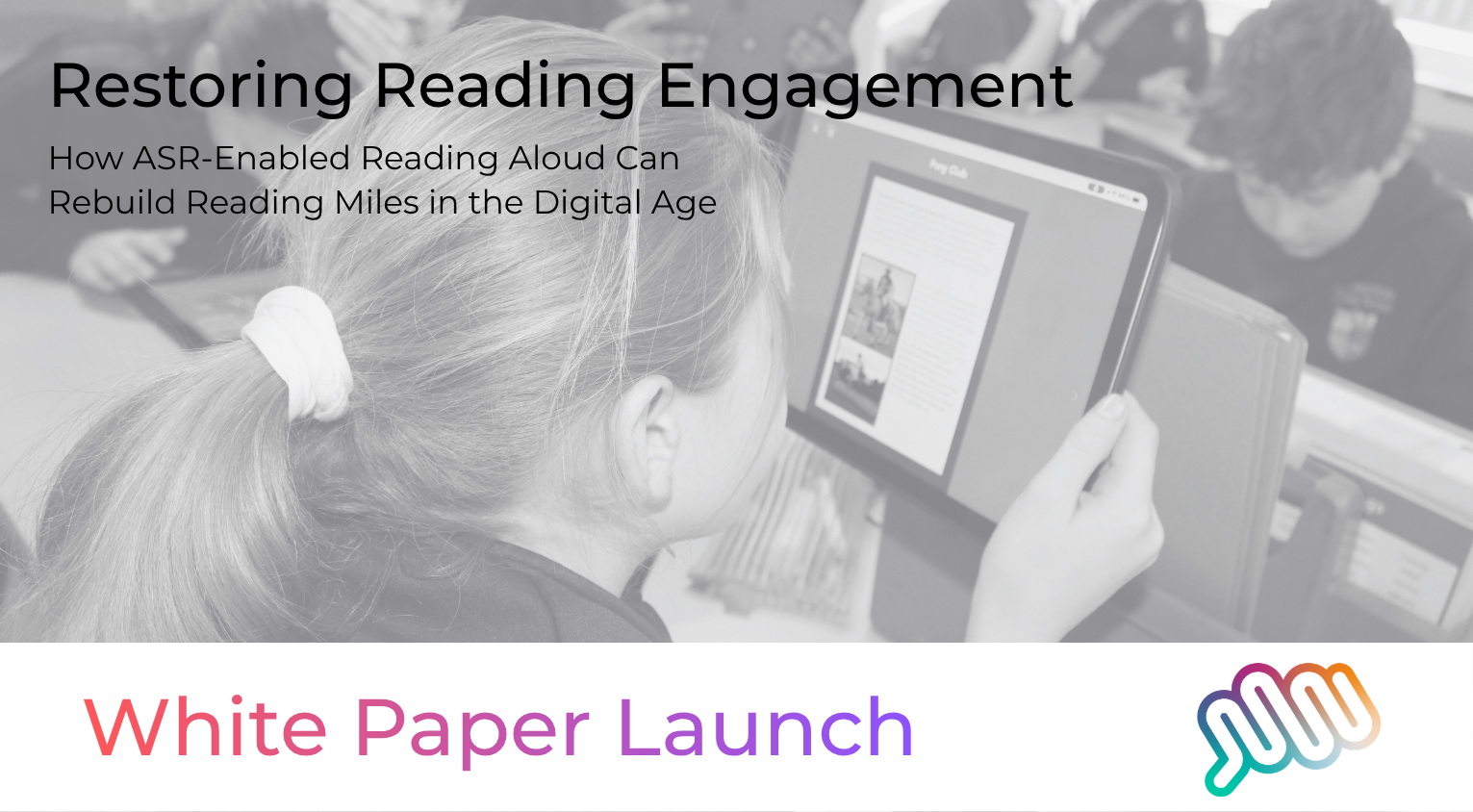
Restoring Reading Engagement: How ASR-Enabled Reading Aloud Can Rebuild Reading Miles in the Digital Age is now available.
